Essential Checklist for Securing Bulk Datacenter GPUs and Server Components
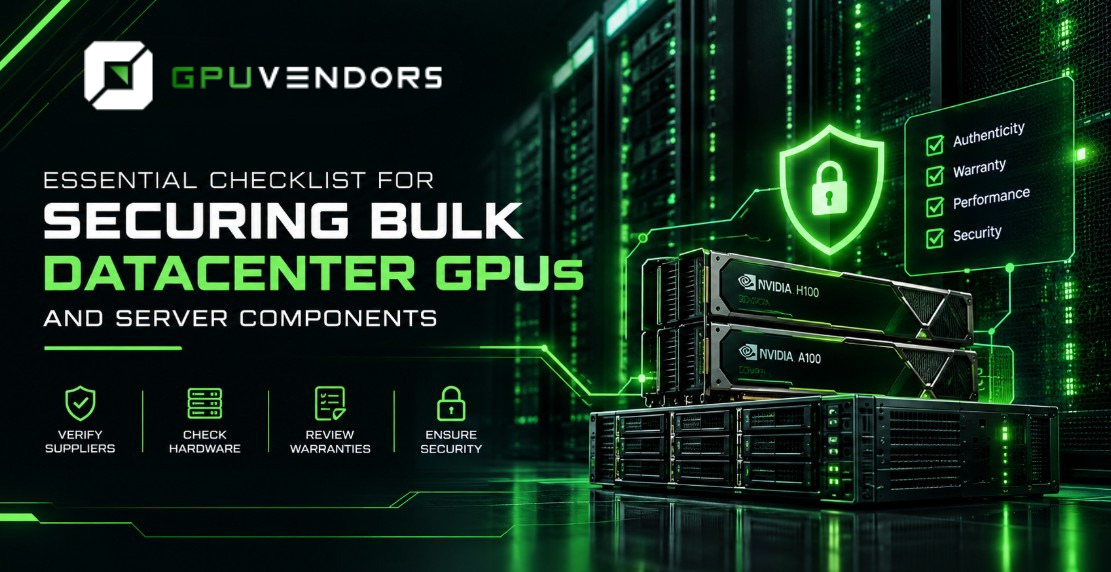
Procuring enterprise hardware for artificial intelligence data centers requires navigating a complex landscape of supply chain constraints, high thermal densities, and strict interconnect standards. When organizations scale up their computing operations, purchasing bulk server components and high-performance accelerators cannot be handled with standard consumer-level procurement approaches. Ensuring that multi-node clusters operate at maximum efficiency begins long before installation, demanding rigorous validation across every layer of the hardware stack. To maintain architectural integrity and secure reliable inventory without falling victim to inflated market markups, IT leaders must follow a comprehensive acquisition framework.
Verifying Vendor Authenticity and Mitigating Supply Chain Risk
The secondary and wholesale hardware markets present significant variables regarding component authenticity and warranty validity. Before issuing purchase orders for high-density accelerators like the H100 or Blackwell series, procurement teams must verify that suppliers maintain direct tier-one relationships or certified distribution channels. Counterfeit silicon, remarked chips, and salvaged mining hardware pose severe risks to enterprise environments, often leading to premature component failure and catastrophic cluster downtime.
Establishing strict compliance checklists helps filter out unverified brokers. Buyers should request verifiable serial numbers, official manufacturer packaging guarantees, and transparent origin documentation for every batch. Utilizing a trusted best gpu marketplace simplifies this vetting process by aggregating verified suppliers, transparent live pricing, and real-time market indexes. This transparency protects enterprise buyers from hidden fees and guarantees that the hardware arriving at the loading dock matches the exact specifications required for mission-critical training tasks.
Aligning Hardware Specifications with Workload Demands
Bulk procurement must never be treated as a generic inventory restock; every node must align precisely with the specific operational workload it intends to host. Large language model training demands dense interconnect fabrics and high-bandwidth memory, whereas live inference workloads often prioritize low-latency networking and balanced CPU-to-GPU ratios. Engineering teams should evaluate power envelopes, thermal design power limits, and scaling requirements early in the planning phase.
Before finalizing hardware counts, architects can model complex multi-node interconnections and review foundational scaling principles outlined in AI Data Center GPU Clustering: H100, B200 & Multi-GPU Setup. Matching precise accelerator configurations to software frameworks prevents bottlenecks in the fabric rails. Utilizing tools such as Choosing GPUs by workload allows technical leads to configure custom AI servers by use case, ensuring that RAM, storage, and accelerator counts match software demands perfectly before bulk manufacturing or shipping begins.
Validating Infrastructure Readiness and Power Constraints
Securing bulk server components is only half the battle; the receiving data center facility must be fully equipped to handle the physical and electrical realities of modern AI hardware. Next-generation server racks consume immense amounts of power and generate unprecedented thermal output, requiring careful calculation of power usage effectiveness, rack weight distribution, and cooling methodologies. Facility managers must audit electrical feeds, PDU capacities, and liquid cooling distribution loops prior to hardware delivery.
Failing to verify facility readiness can result in stranded capital where expensive servers sit unpowered due to thermal or electrical infrastructure limitations. Teams must cross-reference total IT load projections against available floor space, ensuring that cooling systems—whether air-assisted or direct-to-liquid—can support the heat rejection rates of packed server cabinets. By combining rigorous vendor verification, precise workload matching, and exhaustive facility planning, enterprise organizations can successfully deploy resilient, high-performance GPU clusters primed for long-term operational success.