AI Data Center GPU Clustering: H100, B200 & Multi-GPU Setup
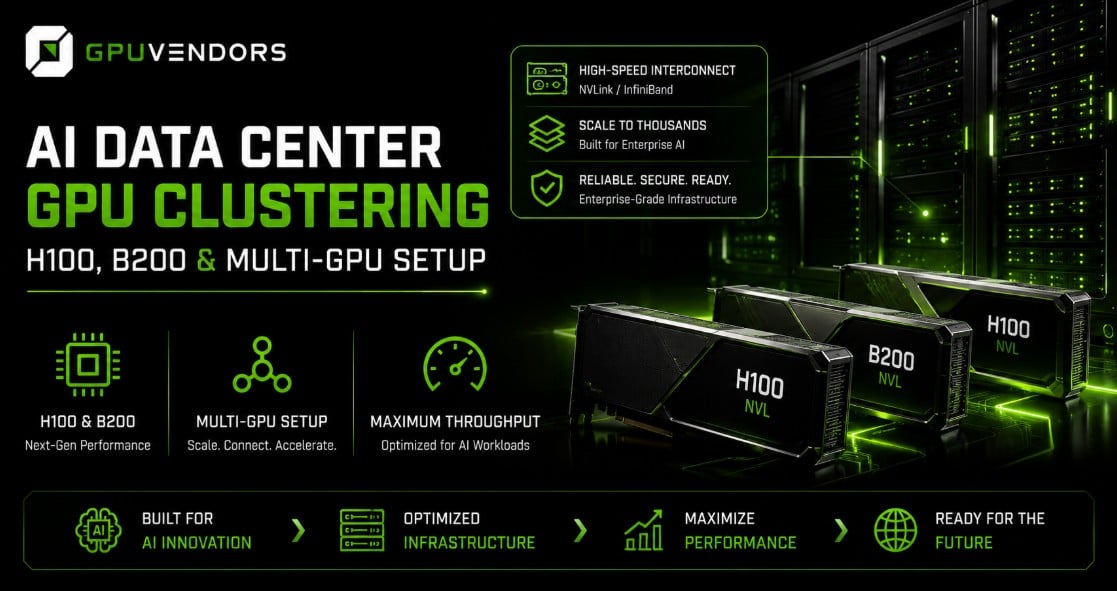
The exponential growth of large language models, deep learning networks, and complex generative artificial intelligence frameworks has fundamentally transformed modern infrastructure requirements. Single-card rendering or standalone workstation configurations are no longer sufficient to handle training workloads that span hundreds of billions of parameters. Instead, enterprise environments rely on massive data center GPU clustering, combining powerful silicon such as the NVIDIA H100 and the advanced Blackwell B200 architecture into unified processing grids. Building these high-performance environments demands careful planning, precise interconnect topology design, and robust thermal management. Organizations seeking to procure reliable enterprise units or explore deployment options can streamline their sourcing process through a trusted best gpu marketplace to secure verified hardware components.
The Evolution of Enterprise Compute: Hopper and Blackwell Architectures
To understand why multi-GPU clustering is necessary, one must examine the leaps made in core accelerator design. The Hopper architecture, anchored by the H100, introduced dedicated transformer engines designed specifically to accelerate neural network training routines by dynamically scaling precision between FP8 and FP16 formats. Building upon this foundation, the newer Blackwell B200 architecture pushes compute density even further by incorporating second-generation transformer engines and massive transistor counts on custom fabrication nodes.
When evaluating these enterprise-grade accelerators against traditional professional desktop cards, engineers often analyze generational throughput and memory bandwidth scaling. For a deeper look at how professional-grade hardware tiers contrast across workloads, reviewing insights outlined in RTX A6000 vs H100 vs L40S: Professional GPU Comparison highlights the distinct performance envelopes separating single-node desktop solutions from dedicated datacenter accelerators. In a cluster configuration, these accelerators must communicate seamlessly, making the underlying interconnect technology just as important as the raw processing power of the individual silicon dies.
The Mechanics of GPU Clustering and High-Speed Interconnects
When multiple graphics processors work together on a single training job, data transfer bottlenecks can severely degrade overall cluster efficiency. If one GPU finishes its computational pass and has to wait idly for gradient updates from neighboring nodes, valuable processing cycles are lost. This challenge is mitigated through specialized high-speed interconnects like NVIDIA NVLink and NVSwitch technologies.
NVLink provides direct, high-bandwidth peer-to-peer communication channels between graphics processors, bypassing the traditional host system memory bus entirely. In an H100 or B200 cluster, NVSwitch architecture scales this capability across multi-node server chassis, allowing dozens of GPUs to share a unified memory space with terabits per second of bidirectional bandwidth. This massive interconnect bandwidth ensures that distributed data parallel training routines maintain near-linear scaling efficiency, even as model sizes expand into hundreds of gigabytes.
Network Fabrics and Distributed Training Topologies
Scaling beyond a single server chassis requires robust networking fabrics that can handle low-latency, high-throughput data exchanges. Modern AI data centers implement InfiniBand architecture or RoCEv2 (RDMA over Converged Ethernet) to connect multiple server racks together. Remote Direct Memory Access allows network adapters to transfer data directly from the memory of one GPU to another without involving the host CPU, drastically minimizing communication latency.
Configuring these network fabrics involves balancing several design parameters, including switch radix, cable length, and topology structure like Fat-Tree or Dragonfly topologies. Each topology choice affects bisection bandwidth and fault tolerance, ensuring that if a single optical link or node experiences degradation, the cluster can dynamically reroute traffic without crashing an active training run that has been running for days or weeks.
Power, Cooling, and Facility Infrastructure Realities
Deploying dense GPU clusters consisting of H100 or B200 nodes introduces extreme demands on data center facility infrastructure. A single high-density rack populated with multi-GPU server blades can draw tens of kilowatts of electrical power, far exceeding the cooling capacity of traditional air-conditioning units. Consequently, enterprise data centers are rapidly transitioning to direct-to-chip liquid cooling systems and specialized rear-door heat exchangers to maintain optimal operating temperatures.
Power delivery must also be meticulously engineered with redundant uninterruptible power supplies and robust backup generation to prevent catastrophic data loss during sudden grid fluctuations. Furthermore, organizations operating hybrid environments that also require local workstations or smaller rendering nodes often need diversified hardware acquisition strategies. For those balancing large cluster investments with smaller desktop deployments or looking to Find the best gaming GPU for your budget, understanding the entire hardware spectrum ensures optimal capital allocation across all operational tiers.
Optimizing Software Stacks for Distributed Workloads
Hardware clustering is only effective when paired with an optimized software stack capable of orchestrating distributed parallelism. Frameworks like Megatron-LM and DeepSpeed utilize tensor parallelism, pipeline parallelism, and zero redundancy optimizer techniques to shard massive models across dozens or hundreds of distinct GPUs.
Developers must configure CUDA streams, collective communication libraries like NCCL, and cluster management schedulers to maximize hardware utilization. Fine-tuning these software parameters prevents memory fragmentation and ensures that communication overhead remains a fraction of total compute time. As artificial intelligence models continue to grow in scale and complexity, mastering both the physical topology of multi-GPU clusters and the software layers that drive them will remain the defining competitive advantage for enterprise technology organizations.