Optimizing Rack-Scale Infrastructure for LLM Workloads
As artificial intelligence models grow increasingly massive and complex, traditional server-by-server provisioning methods are struggling to keep pace. Modern large language model inference and training workloads demand computational density that goes far beyond what standalone chassis can deliver. Enterprise IT and infrastructure teams are realizing that treating individual servers as isolated units creates severe operational bottlenecks in power distribution, thermal dissipation, and internal network latency.
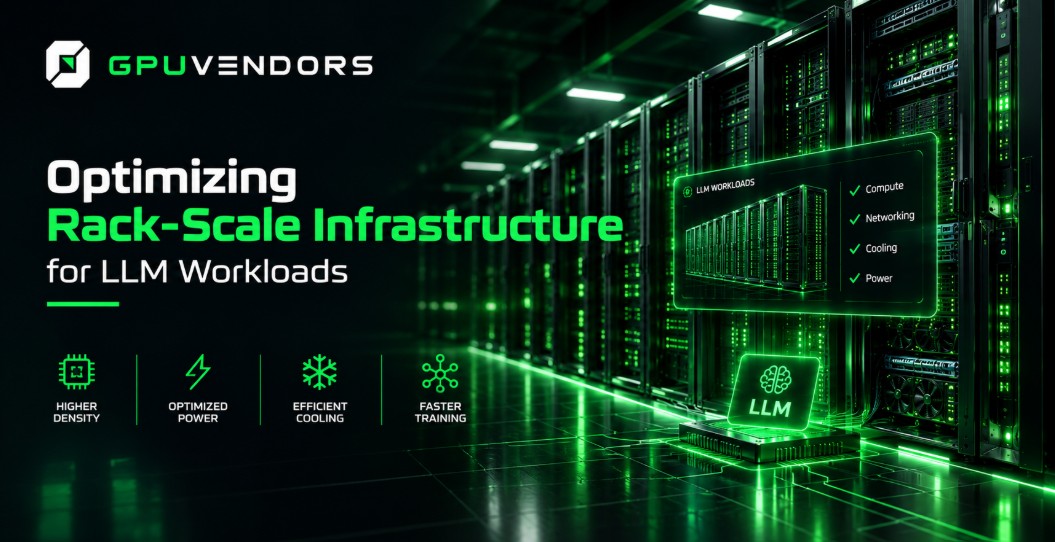
To eliminate these inefficiencies, data center architects are transitioning toward rack-scale infrastructure design. Instead of assembling mismatched components, organizations now deploy fully integrated racks engineered to function as a single, cohesive supercomputing entity. This holistic approach ensures that power supplies, liquid cooling loops, high-speed networking switches, and compute nodes work in absolute harmony to maximize throughput for heavy AI workloads.
The Hardware Pillars of Modern LLM Deployment
Deploying large language models successfully requires a careful balance of accelerator performance, memory bandwidth, and high-speed communication fabrics. Selecting the right silicon components forms the bedrock of any high-performance data center deployment.
When evaluating which processing units best suit your specific throughput and fine-tuning needs, it helps to review industry benchmarks and hardware comparisons. For a comprehensive look at the leading enterprise hardware options available for modern language models, examine the insights on Top 5 Enterprise GPUs for LLM Fine-Tuning and Inference. Aligning your hardware choices with proven accelerator performance ensures your rack-scale build can handle continuous token generation without hitting hardware bottlenecks.
Overcoming Power and Thermal Constraints at Scale
Consolidating dozens of high-performance accelerators into a single rack creates extreme environmental demands. Modern AI server racks consume massive amounts of electrical power, transforming standard data center design assumptions.
High-Density Power Delivery
Feeding multi-kilowatt racks requires robust electrical infrastructure capable of handling high-amperage feeds without voltage sag or power distribution unit failures. Upgrading facility power paths and integrating redundant power supply units prevents unexpected downtime during peak training runs.
Advanced Thermal Management
With massive power draw comes immense heat generation. Standard air cooling frequently falls short in high-density rack configurations. Integrating direct-to-chip liquid cooling systems or specialized rear-door heat exchangers ensures that thermal energy is extracted efficiently, protecting sensitive silicon from thermal throttling and premature degradation.
Sourcing and Configuring Enterprise Rack Solutions
Transitioning to a rack-scale infrastructure model requires a reliable supply chain and precise pre-deployment planning. Sourcing certified server nodes, specialized cabling, and enterprise accelerators without facing long OEM lead times is a primary challenge for procurement professionals.
When acquiring verified components and complete hardware systems for your enterprise build, engineering teams can utilize the best gpu marketplace to secure enterprise-class infrastructure tailored for intensive AI workloads.
Before purchasing physical hardware, it is crucial to model your rack density, power limits, and thermal loads accurately. You can map out your precise node layouts, power requirements, and cooling topologies by using the Build Your GPU Rack tool to ensure your deployment matches your operational capacity.
Conclusion
Optimizing rack-scale infrastructure for large language model workloads is essential for modern enterprise data centers. By treating the entire rack as a unified supercomputing system rather than a collection of separate servers, organizations can overcome power limits, eliminate thermal bottlenecks, and maximize computational efficiency.
Investing in integrated rack architectures combined with reliable hardware procurement ensures your enterprise remains competitive, scalable, and ready for the future of artificial intelligence.