Offloading Neural Rendering: Running DLSS 5 on a Secondary GPU
The rapid evolution of real-time graphics and artificial intelligence has fundamentally altered how hardware handles intensive visual pipelines. For many years, multi-card configurations such as traditional Scalable Link Interface setups faded from mainstream relevance as single-card performance scaled upward to meet standard gaming and rendering demands. However, the introduction of next-generation neural rendering models has completely reshaped performance benchmarks, forcing hardware enthusiasts and system builders to rethink conventional desktop topologies.
With the arrival of advanced AI upscaling and real-time neural texture generation, computational overhead has skyrocketed. Running complex rendering frameworks alongside heavy generative workloads places an immense strain on a single graphics processor. To explore how these cutting-edge visual technologies compare against historical performance expectations, read more about DLSS 5 Rumors and Expectations: What Next-Generation Upscaling Means for Gamers to understand the shifting landscape of high-performance display tech.
Dividing the Computational Burden Between Two Cards
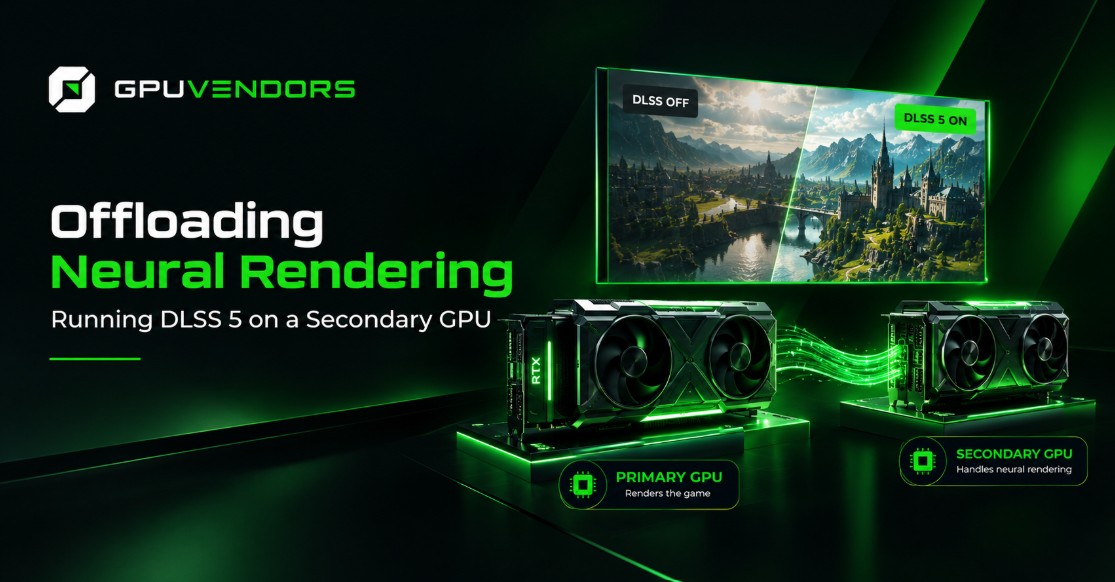
When pushing hardware to its absolute limit with advanced neural enhancement features, a single processor often struggles to maintain high frame rates without severe stuttering or thermal throttling. To bypass these limitations, inventive developers and hardware modders have begun experimenting with dual-card configurations that separate traditional game rendering from AI inference passes.
In these specialized multi-card arrangements, the primary graphics processor handles standard rasterization, geometry generation, and basic frame composition. Meanwhile, a secondary graphics card is dedicated entirely to processing the neural network calculations required for advanced visual enhancement. By isolating the heavy tensor math onto a separate board connected via high-speed PCIe lanes, systems can maintain fluid motion vectors and deliver significantly smoother visual outputs without sacrificing core frame rates.
Hardware Requirements and Sourcing for Multi-GPU Rigs
Implementing a dual-card neural rendering configuration requires careful hardware planning, robust power delivery, and adequate thermal headroom. Because running two high-end graphics processors simultaneously draws substantial electrical current and generates immense heat, standard desktop components will quickly fall short.
System builders need high-capacity power supply units, motherboards with multiple high-bandwidth PCIe slots, and optimized chassis airflow to prevent thermal degradation during extended sessions. When acquiring certified components, power supplies, and secondary expansion cards, procurement specialists can rely on the best gpu marketplace to source verified enterprise-grade hardware components.
Before committing capital to complex multi-card assemblies, it is vital to verify that your power distribution and case dimensions can support the physical and electrical load. You can map out your exact system specifications and thermal layouts by utilizing the AI Infrastructure Configurator tool to guarantee your build operates smoothly under heavy workloads.
Conclusion
Offloading neural rendering tasks to a secondary graphics card offers an intriguing glimpse into how enthusiasts manage extreme computational demands. While this approach requires specialized hardware configurations and robust power management, it effectively mitigates the performance penalties associated with running complex generative workloads on a single processor.
As software optimization and hardware design continue to evolve, balancing compute loads across multiple devices provides a viable pathway for achieving peak visual fidelity and performance in modern high-end computer systems.